
Technology
Total Liquid Immersion with Directed Flow™
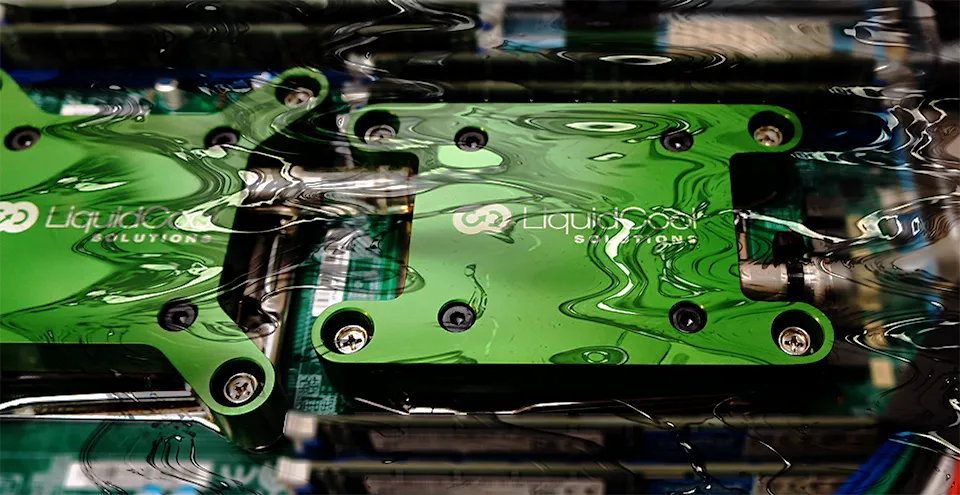
TIDF combines direct-to-chip cooling and total immersion inside one sealed, rack-mounted chassis. The coolest fluid reaches the hottest chips first; then it bathes everything else.
How TIDF works
In short: LCS uses single-phase immersion in a liquid-tight chassis, with flow engineered so that the coolest dielectric fluid passes through the hottest components' heatsinks before immersing the rest of the electronics.
Each heatsink is tested and engineered to provide the correct flow so chips run at their intended temperature. After leaving the heatsinks, the fluid gathers the remaining heat from every other component, then exits the chassis to be cooled and returned. LCS describes the coolant as non-toxic and states it never needs replacing.
Liquid carries heat far more effectively than air, LCS cites roughly 1,000 times better, which is what lets a 2U server dissipate up to the published 4 kW without fans.
Comparison
Four distinct ways to cool servers
These approaches are not interchangeable. Qualitative comparison only; performance depends on hardware, configuration, and site conditions.
| Attribute | Air cooling | Cold-plate direct-to-chip | Immersion tank | LCS rack-based TIDF |
|---|---|---|---|---|
| Heat carried by | Air moved by server fans and room air handling | Liquid through plates on selected chips; remaining components still air-cooled | Dielectric fluid in an open bath; servers lie horizontally | Dielectric fluid in a sealed chassis; directed to hot chips, then immersing everything |
| Conditioned air still needed | Yes | Yes, for components not on cold plates | No for the servers | No for the servers |
| Server fans | Yes | Usually yes | Removed | Removed (fanless) |
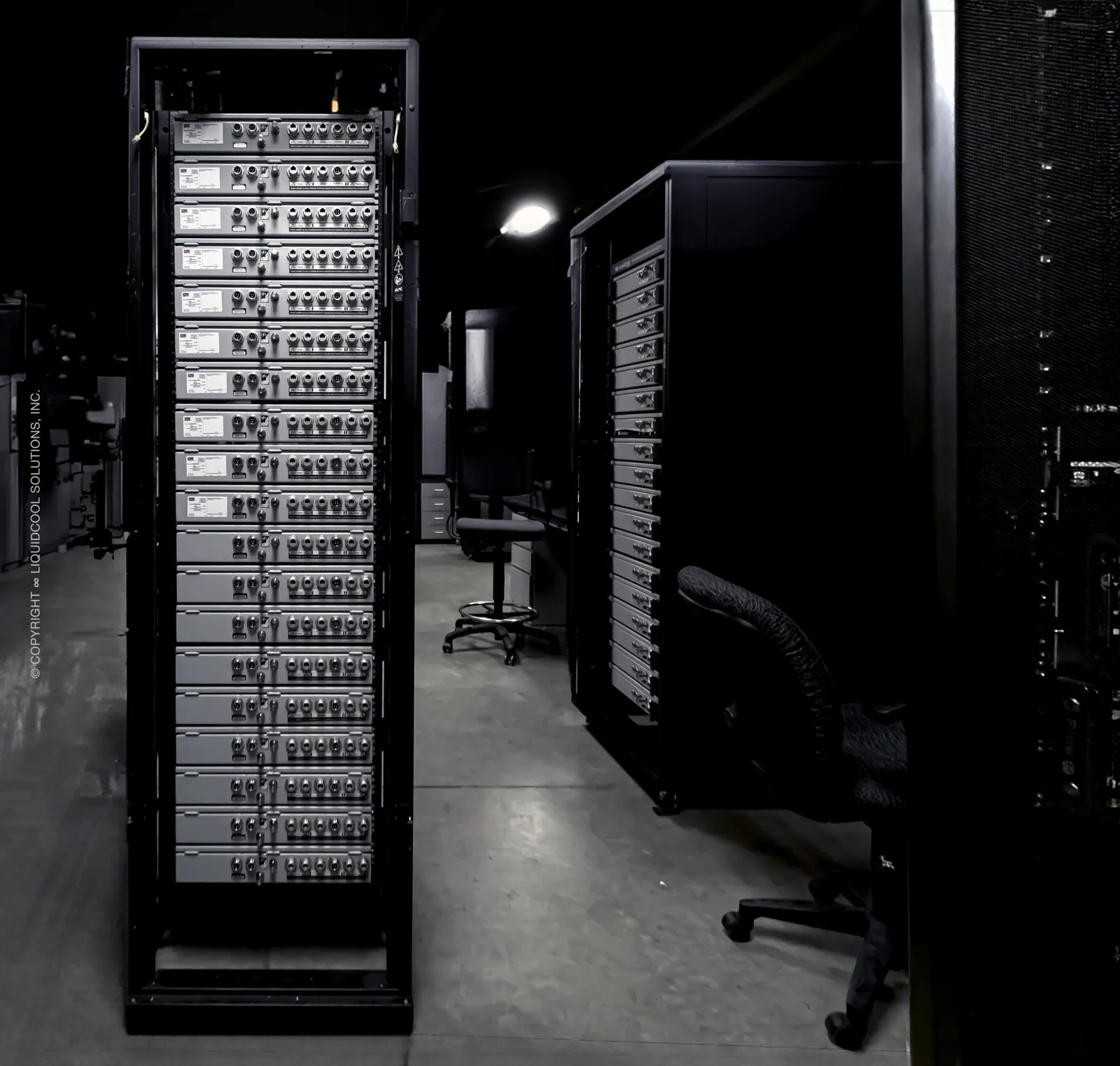
| Rack format | Standard vertical rack | Standard vertical rack | Horizontal tank | Standard vertical 19″ EIA/OCP rack |
| Servicing | Slide out of rack | Slide out; disconnect liquid lines | Lift server out of the bath | Disconnect and slide out of rack |
| Electronics exposure | Exposed to room air, dust, humidity | Exposed to room air | Submerged in open tank | Sealed inside the chassis |
Why LCS chose the rack over the tank
- Simpler migration from air cooling: chassis insert into EIA and OCP racks.
- Servers can be added one at a time.
- Published floor space: 9.5 sq ft per rack vs. 22 sq ft per tank at the same compute density.
- Published fluid volume: about one-third of a tank system, reducing weight and fluid cost.
- Servers are removed from the rack for maintenance.
- Facility water connections from above, as with cold-plate infrastructure; supply water up to 45 °C per LCS.
- Directed inlet flow enables exit temperatures around 60 °C for heat reuse, per LCS.
Space and fluid comparisons are LCS figures; the reference tank system and configuration are pending confirmation.
Questions & answers
Immersion cooling, answered
Glossary
- TIDF
- Total Liquid Immersion with Directed Flow™, LCS's patented method of directing the coolest fluid to the hottest components and then immersing all remaining electronics in the same sealed chassis.
- Single-phase immersion
- Immersion cooling in which the fluid stays liquid throughout; it does not boil (two-phase systems rely on boiling and condensing).
- Dielectric fluid
- A fluid that does not conduct electricity, so energised electronics can be submerged in it.
- Direct-to-chip
- Cooling that delivers liquid directly to a chip's heatsink or cold plate rather than cooling it with air.
- PUE
- Power Usage Effectiveness: total facility power divided by IT equipment power. 1.0 is the theoretical ideal. A cooling-only PUE counts only cooling power and is not comparable with whole-facility PUE.
- TDP
- Thermal Design Power: the heat a processor is designed to dissipate under sustained load, in watts.
- EIA / OCP rack
- EIA-310 is the standard 19″ rack specification; OCP refers to Open Compute Project rack designs.
- Heat exchanger (HEX)
- A device that transfers heat from the server fluid loop to water or air without the fluids mixing.
- dBA
- A-weighted decibels, a sound-level measure adjusted to human hearing.
See also: benefits and how to read each figure · research and field results.
Next step
Let’s solve your cooling challenge.
Tell us about your workload, site, and timeline. An LCS engineer will help you assess whether rack-based immersion fits your infrastructure.